ARAB WORLD PREMIERE
Overview
One of the world’s most celebrated dance companies returns to Abu Dhabi with an extraordinary programme that celebrates the richness and evolution of ballet, from the elegance of the classical tradition to the poetic imagination of contemporary choreography. Bringing together four distinctive works, including a world premiere, the evening highlights the remarkable versatility, artistry, and technical brilliance of American Ballet Theatre’s dancers.
The programme opens with Frederick Ashton’s radiant Birthday Offering, a luminous tribute to the classical ballerina set to Alexander Glazunov’s sparkling score. Originally created to celebrate the twenty-fifth anniversary of the Sadler’s Wells Ballet, the work remains one of the twentieth century’s finest expressions of classical elegance and choreographic musicality. After the interval comes Nuages by the legendary Jiří Kylián, inspired by Claude Debussy’s evocative music. Dreamlike and deeply atmospheric, the work reflects Kylián’s singular ability to unite poetic imagery with expressive movement. It is followed by Trio élégiaque, a new commission by the gifted young choreographer Brady Farrar, set to Sergei Rachmaninoff’s intensely lyrical music and bringing a fresh and compelling contemporary voice to the evening. The programme concludes with the magnificent Paquita, staged by Natalia Makarova after Marius Petipa. Renowned for its regal style, brilliant ensemble work, and dazzling Grand Pas Classique, this enduring masterpiece offers a spectacular finale and a glorious celebration of American Ballet Theatre’s distinguished classical tradition.
Programme
Birthday Offering
Choreography by FREDERICK ASHTON
Music by ALEXANDER GLAZUNOV
(“Concert Waltz No.1,” “Ruses d’Amour,” and excerpts from “The Seasons” and “Scène de Ballet”)
Arranged and Orchestrated by ROBERT IRVING
Costumes by ANDRÉ LEVASSEUR
Lighting by STEVEN SHELLEY
Staged by HELEN CRAWFORD
Birthday Offering is performed by arrangement with The Frederick Ashton Foundation and is one of over 100 ballets created by Frederick Ashton (1904–1988).
These performances are presented as part of the Ashton Worldwide 2024–2028 festival. For further information, visit frederickashton.org.uk
Music by arrangement with European American Music Distributors Company, U.S. and Canadian agent for Schott Music, publisher and copyright owner.
Costumes executed by Barbara Matera, Ltd.
Birthday Offering was created for The Royal Ballet on the occasion of its 25th Anniversary, receiving its premiere at the Royal Opera House, Covent Gardens on May 5, 1956. It entered the repertory of American Ballet Theatre on October 25, 1989 at the Jesse H. Jones Hall in Houston, Texas.
This is, in every sense, a celebration: a ballet created in 1956 to mark the twenty-fifth anniversary of the Sadler’s Wells Ballet, the company that, only months later, would receive its Royal Charter and become The Royal Ballet. It is a tribute from Ashton to the ballerinas who had shaped the company’s identity, and an affectionate homage to the classical tradition from which it had grown.
Set to a selection of Glazunov’s music arranged by Robert Irving, the ballet is conceived as a display of seven ballerinas and their partners, each given a variation tailored to her particular gifts: speed, lyricism, attack, or serene poise. Ashton, often regarded as the most musical of choreographers, weaves these contrasting personalities into a single, gracious whole, crowned by a pas de deux for the leading couple.
In this sense, Birthday Offering looks back to the imperial grandeur of Petipa while speaking with the clarity and refinement of the English style. It calls for the utmost precision and elegance from every dancer and remains one of the most radiant tributes ever made to the art of the ballerina.
INTERMISSION
Nuages
Choreography by JIŘÍ KYLIÁN
Assistant to the Choreographer: GLEN EDDY
Music by CLAUDE DEBUSSY(“Trois Nocturnes”)
Costume Design by JIŘÍ KYLIÁN
Light and Adapted Decor Design by JIŘÍ KYLIÁN
Light and Décor Supervision by BRAD FIELDS
Décor design (original concept) by WALTER NOBBE
Leadership support of ABT’s New Works Initiative is provided by
the Blavatnik Family Foundation, and through an endowed gift from
The Toni and Martin Sosnoff New Works Fund.
World Première
April 30, 1976, Stuttgart, Germany
Stuttgarter Ballett
This is a ballet set to the first of Debussy’s three orchestral Nocturnes, completed in 1899. The composer described the piece as an evocation of the unchanging sky, with clouds drifting slowly and solemnly before dissolving into soft greys touched with white. It is music concerned less with event than with atmosphere, light, and the passing of time.
Kylián created the work in 1976. He responds to Debussy with a duet of remarkable intimacy and restraint. The two dancers seem to drift, merge, and separate like the shapes they evoke, their movement unfolding in long, suspended phrases that mirror the music’s shifting harmonies. The partnering is fluid and continuous, so that the dancers appear weightless, carried by currents rather than steps.
This is an abstract meditation rather than a narrative, a visual poem in which movement and sound become one. In its quiet concentration, Nuages reveals Kylián’s singular gift for uniting poetic imagery with deeply expressive dance.
Trio Élégiaque
Choreography by BRADY FARRAR
Costumes by MARK ERIC
Lighting by BRAD FIELDS
Lead support of ABT’s New Works Initiative is provided by the Blavatnik Family Foundation, and through an endowed gift from The Toni and Martin Sosnoff New Works Fund.
This is a ballet set to music born of grief. Rachmaninoff composed his Trio élégiaque No. 2 in the final weeks of 1893, in the immediate aftermath of the death of Tchaikovsky, his revered mentor and the composer who had championed him from his earliest years. Written for piano, violin and cello, it is a haunting tribute to Tchaikovsky, and its expansive first movement, to which this ballet is set, explores themes of memory, longing and loss.
It is fitting that this work should come from a young artist at the start of his own creative journey. Brady Farrar, a member of American Ballet Theatre’s corps de ballet and an up-and-coming choreographer, made his choreographic debut with the Company this fall. He brings three couples together in a shifting landscape of relationships, as the dancers meet, part and find one another again, much as the three instruments converse, answer and lament.
In this sense, Trio élégiaque is a meditation on the complexities of connection and separation, and on the memories that linger between people long after they have moved apart. It adds a compelling new voice to ABT’s repertoire and offers audiences the rare privilege of witnessing a new work at the moment of its creation.
INTERMISSION
Paquita
Choreographed by NATALIA MAKAROVA after MARIUS PETIPA
Restaged by NATALIA MAKAROVA and NANCY RAFFA
Music by LUDWIG MINKUS
Orchestrated by JOHN LANCHBERY
Sets and Costumes by JOSE VARONA
Lighting by ALEX NICHOLS,
Based on original design by ROBERT THOMSON
By arrangement with Theodore Presser Company, agents for Editions Mario Bois, publisher and copyright owner.
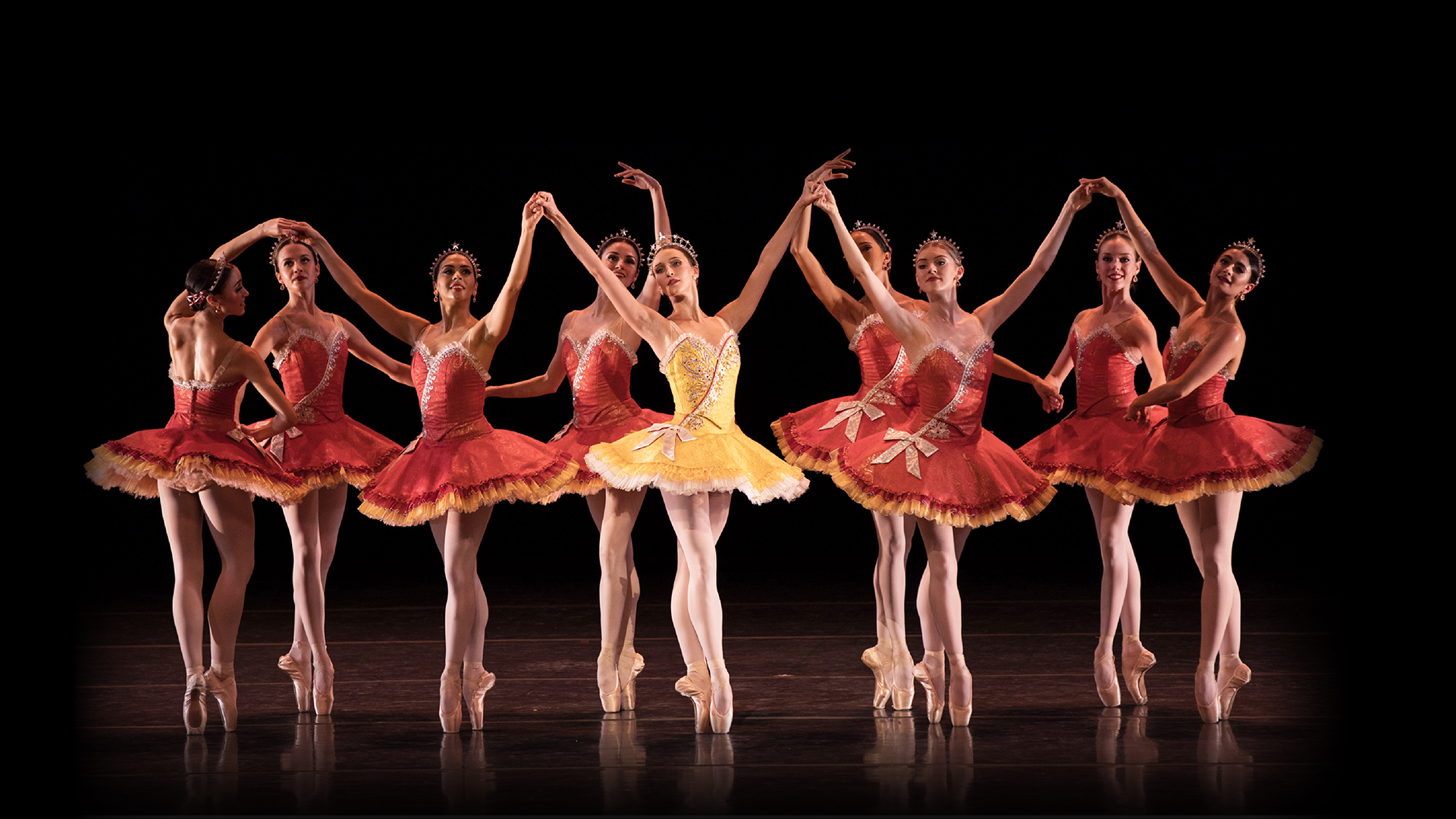
Paquita was first seen in Paris in 1846 and was brought to St Petersburg the following year by the young Marius Petipa, marking the start of his extraordinary career in Russia. Set in Spain during the Napoleonic occupation, it tells the story of a spirited Gypsy girl who saves the life of a French officer and is finally revealed to be of noble birth, free at last to marry the man she loves.
In 1881, Petipa returned to the ballet and added a new Grand Pas to music by Ludwig Minkus for the wedding celebrations. It is this sumptuous showpiece that has endured, long after the rest of the ballet faded from the stage, and it represents classical ballet at its most regal. In a spirit of festivity, the ballerina, her partner, and a glittering ensemble of soloists display the full splendour of the imperial style, culminating in a coda of dazzling virtuosity.
Great dancers have always been drawn to Paquita, and Natalia Makarova, herself one of the legendary ballerinas of the Kirov, staged this celebrated version for American Ballet Theatre in 1984, where it has remained a jewel of the company’s classical repertoire.
ARTISTS
American Ballet Theatre
American Ballet Theatre (ABT) is recognised as one of the great dance companies in the world. Few ballet companies equal ABT for its combination of size, scope and outreach. Founded in 1940, ABT is the only major cultural institution that annually tours the United States, performing for more than 300,000 people. The company has also made more than 30 international tours to 45 countries as perhaps the most representative American ballet company and has been sponsored by the United States Department of State on many of these engagements.
When ABT was launched, the aim was to develop a repertoire of the best ballets from the past and to encourage the creation of new works by gifted young choreographers, wherever they might be found. Under the direction of Lucia Chase and Oliver Smith from 1945 to 1980, the company more than fulfilled that mission. Perhaps unmatched in the history of ballet, ABT’s repertoire includes beloved full-length classics from the 19th century, such as Swan Lake, The Sleeping Beauty and Giselle; many of the finest works from the 20th century, including Apollo, Les Sylphides, Jardin aux Lilas, Fancy Free, Rodeo, Airs, Push Comes to Shove and In the Upper Room; and acclaimed contemporary masterpieces, including Shostakovich Trilogy and Serenade after Plato’s Symposium. Throughout the curation of this repertoire, ABT has commissioned works by celebrated choreographers of the 20th and 21st centuries: George Balanchine, Antony Tudor, Jerome Robbins, Agnes de Mille, Twyla Tharp, Mark Morris, Alexei Ratmansky and Christopher Wheeldon, among others.
In 1980, Mikhail Baryshnikov became Artistic Director of American Ballet Theatre. Under his leadership, numerous classical ballets were staged, restaged and refurbished and the company experienced a strengthening and refining of the classical tradition. In 1990, Jane Hermann and Oliver Smith succeeded Baryshnikov and immediately established an agenda that was dedicated to maintaining the great traditions of the past while pursuing a vital and innovative future.
In October 1992, the former American Ballet Theatre principal dancer Kevin McKenzie was appointed Artistic Director. McKenzie, steadfast in his vision of ABT as American, was committed to maintaining the company’s vast repertoire and to bringing the art of dance theatre to the great stages of the world.
Former American Ballet Theatre principal dancer Susan Jaffe was named Artistic Director in December 2022. Jaffe is dedicated to preserving the beauty and depth of classical ballet while moving the company artistically into the future, expanding ABT’s audience and exploring diverse choreographers and styles.
In keeping with ABT’s long-standing commitment to bringing the finest in dance to the widest international audience, the company has recently enjoyed triumphant successes with engagements in Abu Dhabi, Brisbane, Paris, Muscat, Shanghai and Seoul. On 27 April 2006, the United States Congress honoured ABT by recognising its service as ‘America’s National Ballet Company’.